

A home reformer or a professional studio machine – what’s the real difference?

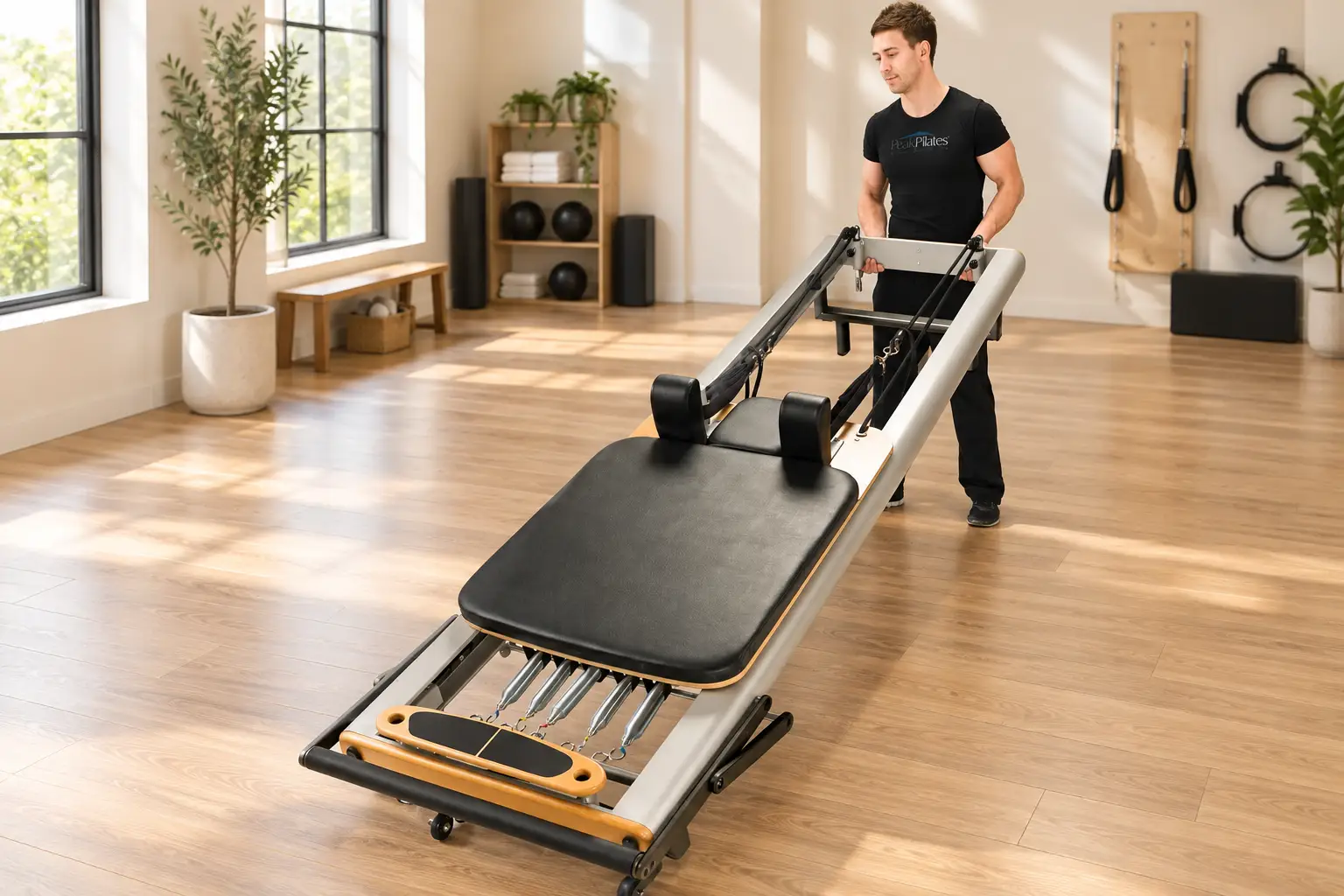
At first glance, a home Pilates reformer and a professional one may look very similar. Both feature a sliding seat, springs, a footbar, straps and a headrest, and a significant proportion of the exercises can be performed on them in exactly the same way.
The real difference, therefore, does not necessarily lie in „what” the machine ‘can do’, but rather in the fact that what it is designed to be used for.
A reformer used by a single person at home a few times a week must meet different requirements to one used in a Pilates studio where classes and clients follow one after the other every day.
The question, therefore, is not simply which is better: a home or a professional reformer. It is far more important to understand in what kind of environment, at what intensity and by whom the machine will be used.
For personal use
A solution optimised for one or a few users, a lower frequency of use and a home environment. It can still be a stable, premium and fully-fledged Pilates piece of equipment.
For intensive studio work
A design intended for frequent reconfiguration, a wide range of users and several hours of daily use, which must also support the studio’s operations.
A home-use reformer is not necessarily „inferior”
One of the most common misconceptions is that a home-use reformer automatically means a simpler, less stable or less professional machine.
That is not necessarily true.
The quality of movement, ergonomics and basic functions of a premium home reformer can be very similar to those of a professional machine.
The Peak Pilates casa™ reformer, for example, has full studio height, a five-spring system, an adjustable footbar, a multi-position gear bar and a carriage design which aims to provide the same exercise experience as in a studio, even in a home setting.
The key difference lies elsewhere.
In the case of the casa™, the manufacturer specifically states that the model designed for home use, and not recommended for commercial or high-volume studio environments.
For professional use, it recommends models such as the fit™, the MVe® or the Artistry® reformers.
The difference between a home-use and a professional reformer is not necessarily apparent during the first workout. Rather, it becomes apparent when the machine is used over months and years at quite different levels of intensity.
The keyword: intensity of use
At home, a cross-trainer is typically used by one or a few people.
We may well train on it every day, but even in that case, we’re talking about a completely different kind of wear and tear to that in a busy Pilates studio.
On a professional machine, the first individual or group session can begin in the morning, and guests can follow one after the other right through to the evening.
People of different heights, weights and levels of experience use the same machine.
The footbar is constantly being adjusted. The springs are replaced several times an hour. The length of the straps is adjusted again and again.
The car can perform several hundred or even several thousand movement cycles in a short space of time.
In this context, it is no longer enough for a reformer to provide a pleasant sensation during a twenty-minute trial session.
The structure must be able to withstand this load in the long term and in a predictable manner must wear.
What makes a reformer a professional?
It is easy to use the term „professional” as a marketing buzzword, yet in reality there are very specific requirements behind it.
Above all, a studio machine must be durable. But it’s not just a question of the frame not getting damaged.
Even after many hours of use, the car must continue to run smoothly.
The footbar mounting must function accurately even whilst being continuously adjusted.
The springs, the straps, the rollers and the various mechanical components must behave as expected even during regular use.
In addition, the quick adjustment is also important.
With a home computer, it’s less of a problem if a setting takes a few seconds longer to apply.
In a group Pilates class, however, with six, eight or ten participants, every unnecessary movement disrupts the rhythm of the class.
Why is quick adjustability important?
Let’s imagine a reformer class, where eight participants are working side by side.
One is taller, the other shorter. One is an experienced practitioner, the other is using the Reformer for the first time.
In one of the exercises, you need to adjust the spring resistance, in the next one, the position of the footbar, and then the straps are used.
The teacher cannot spend a long time on every machine.
It is at times like these that an easy-to-use gear bar, an easily adjustable footbar or a quickly adjustable rope system really come into their own.
On the Peak Pilates fit™ reformer, for example, the four-position footbar, the one-handed gear bar, the adjustable rope system and the three-position headrest all support this quick set-up.
These may seem like minor details in themselves.
However, in a studio that operates for six to eight hours a day, they are already of considerable importance.
Space requirements at home and in the studio are completely different
When buying health foods at home, the first question is often whether Will the machine fit?.
That’s understandable.
In a living room, a guest room or a home gym, every centimetre counts.
It may also be important that the exercise machine can be repositioned from time to time.
The Peak Pilates casa™ has therefore been fitted with integrated transport wheels, whilst the design has been specifically adapted for home use.
In a studio, however, it is not simply the size of a single machine that matters.
If we want to accommodate eight exercise machines, we need to take into account the space between the machines, the instructor’s movement, the reach required during exercises and, of course, safe access as well.
With studio equipment, therefore, it can also be valuable if the design allows for flexible use of space.
The fit™ reformer, for example, can be stored vertically, and also allows several machines to be stacked on top of one another, which can be a significant advantage in space-saving studio set-ups.
At home, we usually ask: is there room for a reformer? In a studio, it’s more a case of: how can we fit in several reformers whilst ensuring the room remains fully usable?
Do we absolutely have to be able to tell the difference in the sensation of movement?
No.
In fact, one of the aims of a well-designed home reformer is precisely to ensure that you have to make as few compromises as possible when it comes to the exercise experience.
Peak Pilates, for example, also manufactures the casa™ model as a full-studio-height machine, and the configuration of its five-spring system follows the same basic principle as that of many of its professional reformers.
This clearly shows that the term „home” does not necessarily mean that we are talking about a miniaturised or toy version.
The difference is much more evident in the intended operating environment and under load cycles.
With a suitable premium home reformer, therefore, you can create a truly authentic Pilates experience.
So why not just take a home computer to a studio?
Because using a machine as intended is not just about the moment of the workout itself.
If a model has been specifically designed for domestic use, then the components, the design, the warranty terms and the maintenance requirements may also be tailored to this environment.
In the case of the casa™, Peak Pilates makes this quite clear: the machine is not recommended for commercial or high-traffic studios.
It designates specific professional models for this purpose.
That is why, when setting up a studio, a cheaper home-based setup may seem attractive in the short term, but in the longer term it can easily turn out to be a bad decision.
And vice versa: can you use professional studio equipment at home?
Of course.
In this regard, there are generally no technical obstacles.
In fact, for those who have a larger space, are planning for the long term and want exactly the same experience at home as they would in a professional studio, a reformer suitable for commercial use could be an excellent choice.
The Peak Pilates Artistry® reformer, for example, is presented as a model built to commercial studio standards, whilst at the same time being considered suitable for home use.
The question in such cases is rather whether we need those features for which we pay when buying a professional-grade machine.
If so, there’s nothing to stop it.
However, if you’re looking for a piece of equipment for two or three home workouts a week, a premium reformer designed specifically for this setting might be a more sensible investment.
Why does the height of the machine matter?
There may be a significant difference amongst the reformers in terms of how high the car is positioned above the ground.
A lower design may give the impression of saving space, whilst the full studio height offers a different user experience.
In a professional setting, a taller machine may also be more comfortable for the instructor, as they do not have to bend down as far when making corrections, adjustments or assisting a client.
For the passenger, too, it affects the nature of both take-off and landing.
That is precisely why it is interesting that, despite the fact that the casa™ was designed for home use, it features a full studio-height design.
This shows once again that when it comes to the difference between a home-based reformer and a professional reformer, we are not necessarily talking about a simple „smaller–larger” distinction.
Extensibility is a major advantage in the studio
A Pilates studio rarely remains completely unchanged for many years.
New types of classes may be introduced, the number of participants may increase, or instructors may wish to expand their repertoire of exercises.
In such cases, it may be advantageous if additional accessories or even a Tower system are available for the reformer.
The Peak Pilates MVe® product range, for example, is specifically positioned as a combination of classic Pilates precision and the space-saving, versatile use that is so important to studios.
It can also be expanded with the MVe® Reformer Tower system.
This is no longer just about that particular machine.
And on the studio’s subsequent development.
Maintenance is important in both cases
We mustn’t make the mistake of thinking that, just because we use our home computer less often, it doesn’t need to be checked at all.
Springs, ropes, straps, rollers and attachment points are all parts on every reformer that are subject to wear and tear or require regular inspection.
The difference lies more in the frequency of the checks.
In a professional studio, due to the high level of use, a much more rigorous maintenance routine may be required.
Unusual noises, a change in the suspension’s feel or a worn-out strap are not the sort of things you should ignore for months on end.
At home, it is just as important to follow the manufacturer’s instructions – the strain caused by use may simply be less.
The perspectives of the instructor and the person practising at home differ
When buying a home exercise machine, one of the biggest advantages is that you can adjust the machine to suit your own needs.
If the same person uses it every day, their preferred settings will become established in no time.
In a studio, exactly the opposite happens.
The machine must constantly adapt.
As one guest leaves, the next arrives, with different body measurements and different experiences.
That is why, with a professional exercise machine, as well as adjustability, it is also important that the individual positions are clear and can be reproduced quickly.
This small difference in day-to-day teaching work can prove to be very significant.
When should you choose a home exercise machine?
In that case, if we’re buying the machine for personal use, one or a few people will be using it regularly, and there’s no need for it to be used for several hours a day to cater for various customers.
With a good home reformer, you still don’t have to compromise on a sturdy frame, a proper spring system, precise carriage movement or a full Pilates experience.
The Peak Pilates casa™ is designed to fill precisely this gap: a model designed for home use, whilst retaining many of the features found in professional machines.
When should you definitely consider using professional-grade equipment?
If we are fitting out a Pilates studio, fitness centre, hotel or other high-traffic facility that caters for paying customers, it is worth choosing equipment designed for professional use from the outset.
It’s not just a question of whether the reformer can „cope” with the training.
The daily usage cycle, the ability to switch set-ups quickly, the long-term availability of spare parts, maintainability and the efficiency of the studio’s operations are all factors in the decision.
A professional reformer is not professional simply because it allows you to perform more exercises on it. It is professional because it has been designed to be a reliable piece of equipment in a professional setting, even under heavy loads, over the long term.
Summary: a home or professional reformer?
The difference between the two categories may be far less striking than one might initially think.
A premium home reformer may feature studio-height, a professional-grade spring system, a stable carriage and an excellent exercise experience.
However, this does not mean that it cannot still be a device designed specifically for private use.
With a professional exercise machine, the focus is on intensive, repeated use, quick adjustability, durability and support for the studio’s day-to-day operations there is.
That is why it is not worth making your choice based solely on price or appearance.
When choosing a machine for home use, opt for one that provides an appropriate exercise experience, stability and functionality for your own training.
And for the studio, one that the manufacturer has designed specifically for this environment.
The real difference does not necessarily lie in what the reformer looks like. But rather in the kind of life it was designed for.
Frequently Asked Questions
Is a home-use reformer worse than a professional one?
No. A premium home reformer can provide an excellent workout experience and a high standard of equipment. The most important difference is usually the intensity of use for which it is designed.
Can a home Reformer be used in a Pilates studio?
You must always follow the manufacturer’s instructions. Peak Pilates, for example, has designed the casa™ reformer specifically for home use, and does not recommend it for commercial or high-traffic studios.
Can I use a professional reformer at home?
Yes. Provided there is sufficient space available and you are looking for a higher-end model, a professional reformer can also be used in a home setting. Some models are specifically designed to be suitable for both settings.
Can the same exercises be done on a home reformer?
On a well-designed premium home reformer, a significant proportion of the classic reformer repertoire can be performed. However, the exact possibilities are always determined by the design of the specific model and the accessories available for it.
Why does a professional reformer usually cost more?
It’s not just about the brand name. Professional equipment is designed for more intensive use, frequent adjustments and long-term studio work. The construction, the components, the functionality and the expandability can all affect the price.
When opening a gym, is it worth starting with cheaper home exercise machines?
It may seem like a more cost-effective investment in the short term, but if the machines are used for several hours a day, it is worth considering models designed specifically for commercial use from the outset. The manufacturer’s intended use, the expected workload and long-term operation may be more important than the initial purchase price.
Which Peak Pilates reformer is designed specifically for home use?
A casa™ Reformer a model designed specifically for home use. Peak Pilates models for professional or high-volume use include, amongst others, the fit™, MVe® and Artistry® offers a range of models.
The team of experts at Peak Pilates Hungary
Through the expert content provided by Peak Pilates, we aim to help ensure that purchasing a Reformer is not merely a matter of comparing price, design or a few technical specifications. The needs of a home user differ from those of a professional studio, so choosing the right piece of equipment must always be based on its intended use. A good reformer is not simply the one who knows the most – but the one that has been designed specifically for the purpose we need.


