

How to choose a Pilates studio? – 8 things to consider

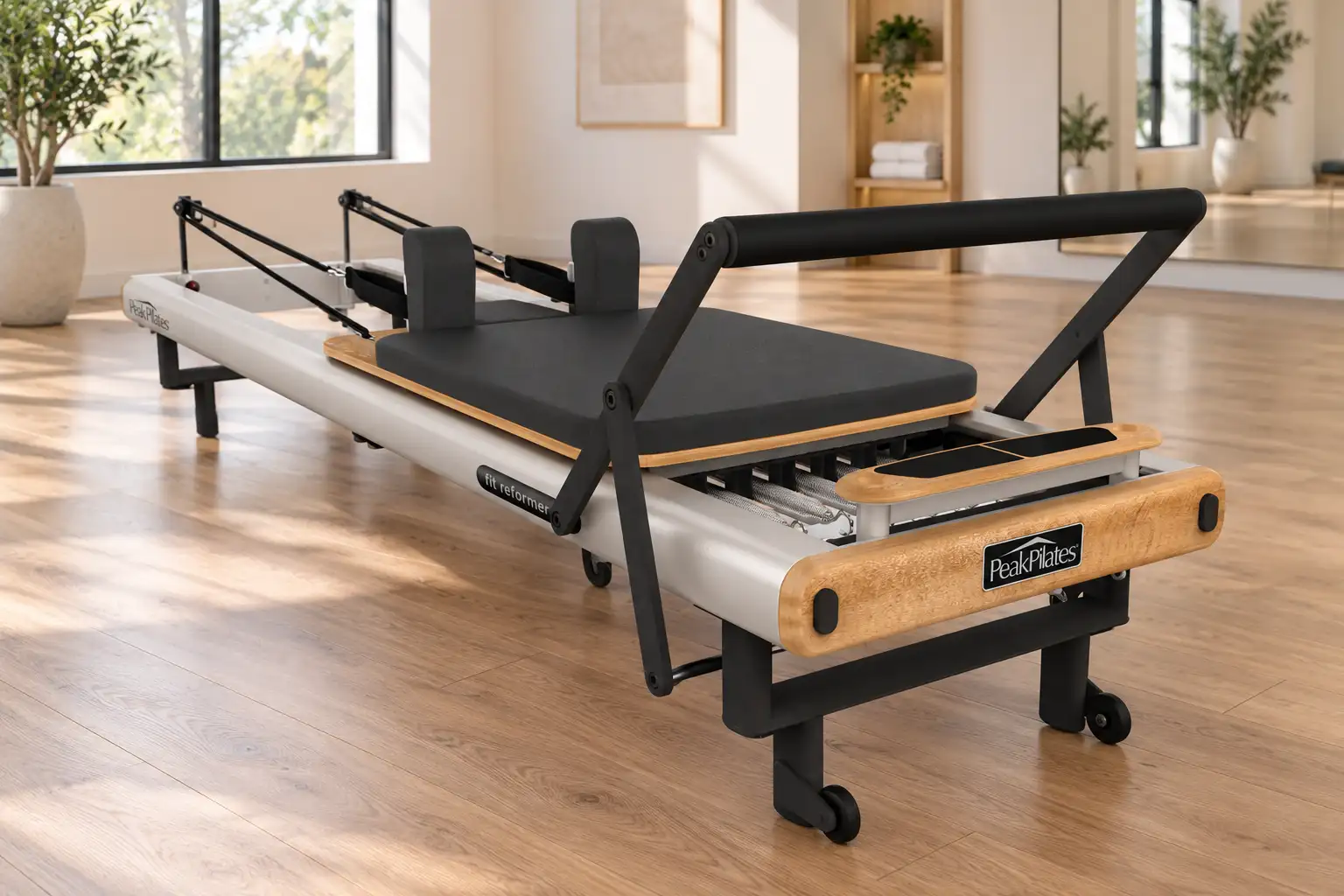
Choosing the right Reformers for a Pilates studio is a much bigger decision than simply deciding which machine you like best. Choosing the right reformer will shape the studio’s day-to-day running, the instructors’ work, the guest experience and even the maximum number of people with whom a class can be comfortably held, for many years to come.
That is precisely why, before making a purchase, it is worth comparing not only the price and appearance, but also the load capacity, the dimensions, the adjustability, maintenance requirements and future expandability.
As is clearly evident from Peak Pilates’ current range, there is no single reformer suitable for every purpose: the casa™ is specifically designed for home use, whilst the fit™, MVe® and Artistry® models include designs intended for professional studios.
The question, therefore, is not which is the best reformer in general, but rather which one is best suited to the way your studio operates.
8 things to consider before making a purchase
1. How much load will the reformer have to bear?
Let that be one of the first questions.
In a small private studio, where a few one-to-one sessions take place each day, the equipment is used in a completely different way than in a group studio with eight to ten reformers, where classes follow one after the other from morning until evening.
Professional use does not simply mean that lots of people use the same machine.
Every moving and adjustable part of the reformer is subjected to a much more intense load.
The trolley runs along the track over and over again. The springs are constantly being replaced. The footbar is adjusted to different positions. The straps and ropes are adjusted to suit different body sizes.
It is therefore advisable to choose a model for the studio which the manufacturer has designed from the outset for professional or high-volume use.
Peak Pilates, for example, explicitly states in relation to the casa™ model that it is designed for home use, and for high-traffic studios, instead, it recommends, amongst others, the fit™, MVe® or Artistry® ranges.
One of the most important features of a studio machine is not how a workout feels on it, but rather how consistently it can deliver the same experience even after the hundredth and the thousandth hour.
2. How much space is available?
One of the most common mistakes made when choosing a reformer is that people choose the machine first, and only then try to fit it into the studio.
In the studio, it’s worth doing it the other way round.
First, you need to work out how many clients you want to work with at any one time, how much space is required around each reformer, and how the instructor will move between the machines.
It is not enough simply to multiply the factory length and width of the reformer by the required number of machines.
During the exercises, the legs, the arms or various accessories may extend beyond the frame.
The instructor must be able to approach the passenger, and getting in and out must remain comfortable.
With eight or ten machines, even a difference of a few centimetres can be significant.
And if the hall is used for different types of classes, it becomes even more important that the equipment can be moved or stored.
3. What sort of lessons would you like to teach?
Not all Pilates studios operate in the same way.
There are some places where mainly classic Reformer classes are held. Other studios offer more dynamic group classes, whilst others place great emphasis on one-to-one tuition, Tower work or the use of the full range of classic equipment.
This has a direct impact on the choice of the right machine.
If you wish to work primarily within the classical Pilates approach, the dimensions of the reformer may be important, as may the strap or rope system and the extent to which the machine adheres to the classical design.
If you work with larger groups, the ability to set up quickly and having a standardised fleet of machines may become more important.
And if you’d like to incorporate Tower exercises into the service, it’s worth choosing a system right from the start that can be expanded later on.
The Artistry® Reformer, for example, can be used as a stand-alone reformer, whilst it can also be upgraded with the Tower system.
The Peak Pilates Artistry® TWS, meanwhile, is designed for studios that wish to combine Reformer and Tower programming on a single wooden-framed unit.
Don’t just think about what classes you’ll be running when you open. Think also about what services you’d like to offer in two or three years’ time.
4. How quickly can the machine be adjusted?
This is the feature which, in a showroom, can easily seem insignificant, but which, during day-to-day studio work, very quickly becomes essential.
In a one-to-one lesson, a few extra seconds don’t make much difference.
In a Reformer class with eight participants, the situation is quite different.
If the footbar, springs, rope length or headrest have to be adjusted individually for each participant, the instructor will very quickly realise just how important a well-designed adjustment system is.
The easy-to-use gear bar, the clearly defined footbar positions and the quickly adjustable strap or rope system are not just flashy marketing features.
They set the pace of the lesson.
A good reformer allows the instructor to focus on the participants, rather than constantly having to adjust the machines.
5. Wood or metal – and how important is design?
We have previously written in more detail about the choice between wooden and metal reformers, but when designing a studio, it is particularly important to revisit this issue.
The Reformers are the largest and most striking pieces of equipment in a Pilates studio.
If we place six, eight or ten machines side by side, they effectively set the tone for the entire interior space.
A reformer with a wooden frame can create a more natural, more classic and more elegant atmosphere.
The Peak Pilates Artistry®, for example, is available in solid beech or walnut finishes, and the brand specifically intends it to be a centrepiece in classic, premium studios.
Metal-framed exercise machines can lend a more modern, technological feel, and with certain designs, portability or storage also play a more important role.
However, it is important not to fall into the trap here of assuming that wood is automatically a premium material, whilst metal is merely functional.
Both can provide an excellent professional solution.
6. What are the car, the suspension and the overall driving experience like?
It is not worth choosing a reformer based solely on a catalogue.
Technical specifications are important, but a significant proportion of the reformer’s most important features can only be appreciated whilst using it.
How smooth is the car’s ride?
How quiet is it?
How does it perform at low speeds?
How do the springs feel?
How stable is the footbar?
How does the machine respond to a change in the centre of gravity?
Together, these factors determine what the guest ultimately perceives as a „good reformer”.
In the current generation of Peak Pilates Artistry®, for example, the brand particularly highlights the five-spring system and the quiet, smooth movement of the carriage.
This is important because one of the cornerstones of Pilates practised on the Reformer is control.
If the machine’s movement is unpredictable, noisy or jerky, this directly detracts from the experience.
Ideally, a good reformer does not seek to draw attention to itself. It is good precisely because it allows the instructor and the client to focus on the movement rather than the machine.
7. How can maintenance and the supply of spare parts be organised?
This is a less exciting topic than design or the suspension system, but as a studio owner, it is one of the most important issues in the long term.
A professional exercise machine contains spare parts.
Springs, ropes, straps, wheels and various fastenings may need to be checked or replaced over time.
That’s normal.
The problem arises when the necessary spare part is difficult to source, or when a machine is out of action for a prolonged period due to a simple repair.
In an eight-machine studio, the failure of a single Reformer can reduce a group’s maximum capacity by more than ten per cent.
This is a direct business issue.
Before making a purchase, it is therefore worth asking not only how much the reformer costs, but also how the spare parts supply works, what maintenance the manufacturer recommends, and what support is available in the long term.
Peak Pilates maintains separate product manuals for several of its current and previous Reformer models, which provide important background information for their proper operation and maintenance.
8. Don’t just look at the price of the machine – think about the total investment
With ten reformers, even a relatively small difference in unit price amounts to a significant sum.
That is precisely why it is understandable that, when opening a studio, price has a significant influence on the decision.
However, on its own, the purchase price can be misleading.
The fleet of vehicles as a multi-year investment It is worth dealing with.
If a more expensive reformer operates more reliably in the long term, can be adjusted more quickly, is easier to maintain, or can be upgraded later with the Tower system and other accessories, then the initial price difference may become much smaller over time.
Looking at it from the other side, there’s no point in paying for features that the studio never actually uses.
That is why the ideal fleet is not necessarily the most expensive.
A standardised fleet or a variety of reformers?
In the case of a new group fitness studio, there are generally many advantages to having a standardised range of equipment.
If all the participants are working on the same model, it is easier for the instructor to give instructions.
The same spring setting, the same footbar position and the same machine geometry apply to everyone.
Guests don’t have to learn how to use a new machine every hour either.
The supply of spare parts and maintenance could also become simpler.
However, in a studio that specialises mainly in one-to-one tuition or classical Pilates programmes, it may well be justified to use a variety of machine types.
So, once again, there is no single rule that applies to every studio.
It’s worth thinking ahead about expansion
Many studios start out with four or six Reformers, and then, after a few months or years, they want to expand.
If this is a realistic option, it is worth checking, even before making your first purchase, whether the model in question is likely to remain available in the future, what accessories are included, and how it can be integrated into a larger system.
A reformer that can be expanded with the Tower can, for example, significantly broaden the range of services offered without having to replace the entire fleet of machines.
The Artistry® system offers this option for further development.
Summary: How do you choose a Pilates studio?
Choosing the right reformer is not a matter of a single technical specification.
You need to consider how intensively the machines will be used, how much space is available, what types of classes you’d like to run, how important quick set-up is and how well the equipment fits in with the studio’s visual aesthetic.
Equally important are the quality of movement, maintainability, the availability of spare parts and future expandability.
Ultimately, the eight criteria all lead to the same question:
How well does a particular reformer suit the studio that you actually want to run?
It’s not certain that the most expensive model will be the right one.
I’m not sure if it’s the most beautiful.
And it’s not certain that the machine which works perfectly in another studio will be ideal for you either.
A good studio machine is not merely a piece of Pilates equipment. It is one of the most important tools for day-to-day operations – which is why it’s worth choosing one carefully.
Frequently Asked Questions
How many instructors should you have when setting up a Pilates studio?
There is no single ideal figure that applies to every studio. The available floor space, the business model, the type of class planned and the target group size all play a part in determining this. It is more important to ensure there is sufficient space between the machines than to fit in as many reformers as possible.
Can a home exercise machine be used in a gym?
You should always follow the manufacturer’s recommendations. Peak Pilates, for example, designs the casa™ reformer for home use, and recommends its other models for professional, high-traffic environments.
Should I choose a wooden or metal reformer for my studio?
Either option may be suitable. The choice should be made primarily on the basis of the studio’s intended use, its design, the required manoeuvrability and the construction of the model in question. It is worth making the decision based on these factors.
Is it important for all reformers to be the same?
This can be a significant advantage in group classes. With identical machines, training is simpler, as is communicating spring settings and carrying out maintenance. However, in a studio based on one-to-one training, it may be necessary to have a variety of equipment.
Is it worth choosing a reformer that can be upgraded with a Tower?
If, in the longer term, you’d like to offer the Tower programme or a broader range of classic Pilates exercises, then yes. In this case, the expandability of the system means that your equipment can be upgraded later to include new services.
What is the most important thing in a professional reformer?
There is no single feature that is more important than all the others. Durability, ride quality, the suspension system, adjustability, stability, ergonomics and serviceability all combine to determine how well the machine performs in a studio environment.
Should I try out the reformer before buying it?
If possible, definitely. The car’s handling, the character of the suspension, the feel of the footbar and the overall ergonomics are difficult to assess based solely on catalogue specifications.
The team of experts at Peak Pilates Hungary
Through the professional guidance provided by Peak Pilates, we aim to help ensure that the selection of equipment for a Pilates studio is a well-informed, long-term decision. The right Reformer must not only be suited to the teaching method, but also to the available space, the client base and the studio’s business operations. A well-chosen reformer will not only be a piece of equipment in the studio for years to come, but also one of the cornerstones of the studio’s day-to-day operations.


