

A wooden or metal reformer? – Which one is best suited to which environment?

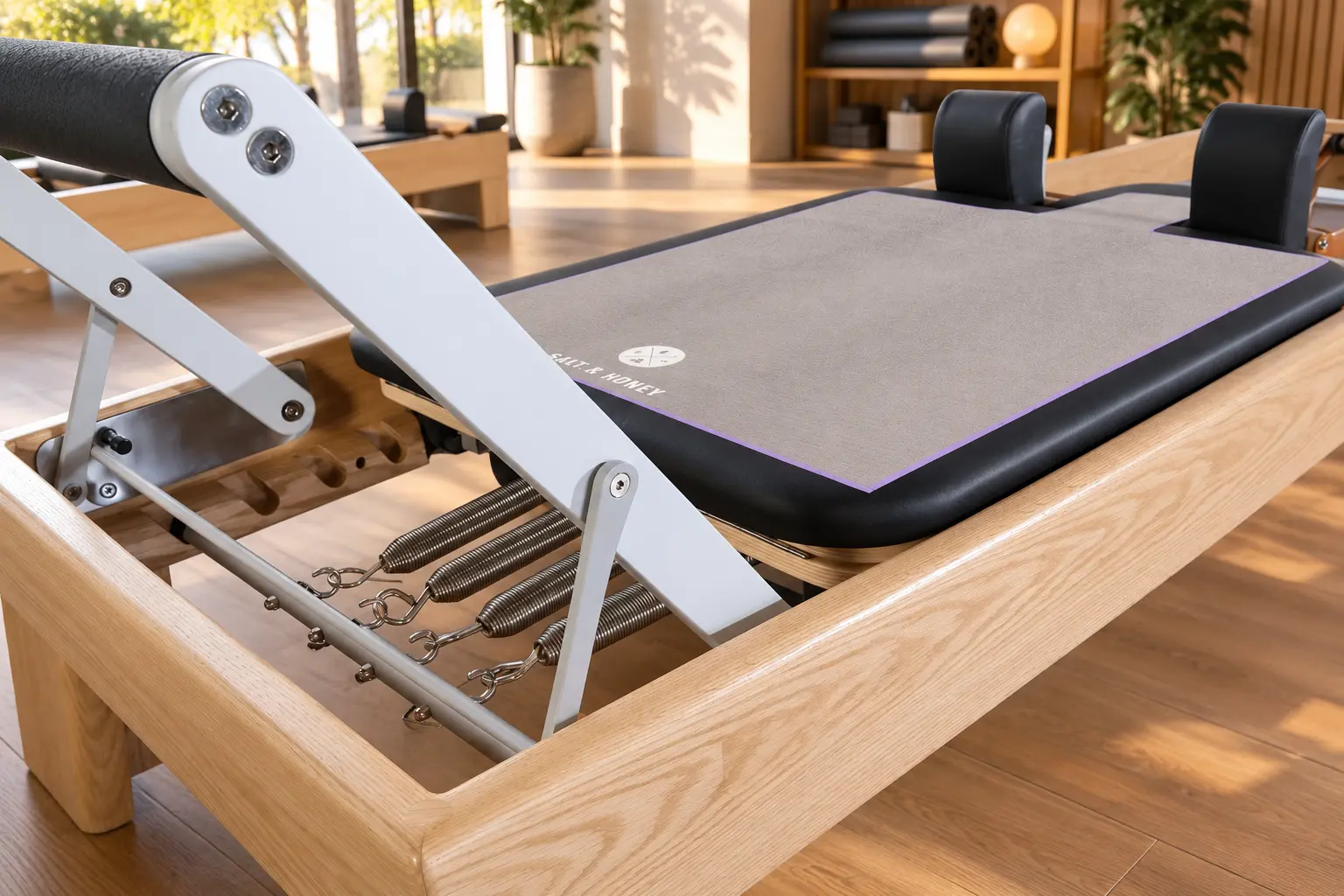
One of the most striking differences when choosing a boiler is the material of the shell. Wooden reformers give a classic, warm and premium look, whilst machines with metal frames generally have a more modern, light and airy feel.
However, the decision should not be treated merely as an aesthetic issue. The available space, the frequency with which equipment is moved, the intensity of use and the studio’s concept itself can all influence which layout is best suited to the given environment.
It is important to clear up a common misunderstanding right at the outset: A wooden reformer is not, in itself, better or more professional than a metal one, and the reverse is also true.
Both designs can result in high-quality machines designed for professional use. The real difference always lies in the overall design of the reformer, its stability, its movement and the specific environment in which it is used.
Classic and distinctive
With its natural, warm appearance, it can form a strong part of the visual identity of a boutique studio, wellness centre or premium home space. It can work particularly well where there is a permanent fleet of machines.
Modern and flexible
It can give the space a cleaner, more technical look. In the case of certain structures, a more compact design or greater portability can be an advantage in multi-purpose rooms.
It’s not just about looks
If we place a wooden and a metal reformer side by side, the contrasting characteristics of the two machines are immediately apparent.
The natural texture of the wood stands out much more prominently in the space. In a classic or boutique Pilates studio, it can even be one of the defining features of the entire interior.
Metal radiators, by contrast, often have a lighter, more modern look. They can fit in particularly well with minimalist, light-coloured or urban settings.
However, appearance is only the first layer.
We use a reformer for years on end, in a professional studio for several hours a day at times. For this reason, when making your choice, it’s also worth considering how the machine will perform in day-to-day use.
A good piece of fitness equipment doesn’t just look good in the studio. It also fits in with the way we use the space.
What makes a wooden reformer special?
Perhaps the greatest appeal of wooden reformers is that classic Pilates atmosphere, which is created simply by the appearance of the natural material itself.
A meticulously crafted wooden frame provides a strong, stable structure, whilst visually giving the impression of a premium piece of furniture rather than a traditional exercise machine.
This may be particularly important in Pilates studios where the experience does not begin with the very first exercise.
Guests are introduced to the brand and the studio’s philosophy the moment they walk through the door.
The lighting, the finishes, the colours, the reception area and, of course, the fleet itself all combine to create that first impression.
A wooden reformer in this setting is not just a tool.
It could become part of the studio’s visual identity.
In what sort of environment does wood really thrive?
It is particularly well suited to studios where reformers have a permanent place.
If the studio is used exclusively or primarily for Pilates, and there is no need to move or rearrange the entire range of equipment after every class, a more robust wooden structure can be particularly advantageous.
In a boutique studio, a wellness centre or a premium home gym, the natural look of wood can also add a great deal to the ambience.
Light-coloured wood, for example, can work well with natural colours, stone surfaces, plants and plenty of natural light.
With darker wood, you can create a truly classic, elegant Pilates studio atmosphere.
However, wood is a natural material
This is one of the advantages of this look, but it also means that it requires the right environment and care.
A professional Pilates reformer is, of course, a well-built piece of equipment designed for long-term use, but that does not mean it should be exposed to extreme levels of humidity or moisture over a prolonged period.
When cleaning, you should always follow the manufacturer’s instructions.
Aggressive chemicals or unsuitable cleaning products are not necessarily good not only for the surface of the wood, but also for the upholstery, metal parts and other components.
A professional exercise machine is a long-term investment. The right environment and regular maintenance are just as important as the choice of machine itself.
What does a metal reformer offer in comparison?
Metal reformers take a different approach.
In many cases, their appearance is more modern, more technical and more understated. The frame itself is less dominant in the space, which can work particularly well in studios where the aim is to create a clean or minimalist interior.
When designing certain models with a metal frame, easier manoeuvrability and more flexible use of space are also important considerations.
However, this does not mean that All metal reformers are lightweight, nor do I believe that every wooden reformer is difficult to move.
The actual difference must always be assessed on the basis of the size, weight and design of the model in question.
Metal alone does not reveal what the machine is capable of.
When a room serves multiple purposes
This is where the design can become particularly important.
Let’s imagine a studio where Reformer classes are held in the morning, whilst in the afternoon, in the very same room, mat Pilates, stretching or other group classes take place.
In this case, the regular reorganisation of the vehicle fleet is already part of day-to-day operations.
A reformer whose design facilitates easier movement or more practical storage can save you a lot of time and energy.
However, if the reformers remain in the same place from morning till night, this consideration is far less important.
What about stability?
It is a common misconception that wood is automatically more stable, whilst metal is lighter and less robust.
That is not generally true.
A professionally designed metal frame can be extremely stable, just as a properly constructed wooden structure can be.
Stability is not determined solely by the material.
The frame’s geometry matters, as do the joints, the machine’s weight, its contact with the ground and the design of the entire structure.
Ultimately, what matters to the practitioner is not what material the frame is made of.
You will notice that how predictable and stable the machine is whilst in motion.
The quality of the reformer’s movement is more important than the material
One of the most important parts of a reformer is the moving carriage.
The carriage must run smoothly and predictably along the track.
This is complemented by the springs’ smooth operation, the stability of the footbar, the strap system and the various adjustment options.
If these work well, the practitioner’s attention can be directed towards their own body and their movements.
However, if the bike feels sluggish, or is unsteady or unstable, then the frame’s aesthetics become a secondary consideration.
That’s why it’s worth being cautious when shopping, bearing in mind that „wood = premium”.
It is not the materials that make a premium exercise machine premium, but the way the whole system works.
Boutique Pilates studio: here, design is also a business factor
However, even in a boutique studio, the importance of aesthetics should not be underestimated either.
Reformers are often the largest items in the room. If eight or ten machines are placed side by side, they effectively determine the entire visual character of the room.
In this setting, wooden reformers can create an elegant, classic and natural look.
In a contemporary studio, however, it may well be a minimalist fleet of metal machines that best supports the brand’s image.
There is no rule stating that a premium studio must always choose wooden machines.
It is harmony, rather than anything else, that creates the premium experience.
In group reformer classes, even centimetres count
A difference of a few centimetres in a single reformer doesn’t seem particularly important.
However, with ten machines, it certainly does.
The width and length of the reformers affect how many machines can fit comfortably in the hall, how much space there is between them, and how the instructor can move about amongst the participants.
That is why, when opening a new studio, it is not enough simply to work out how many Reformers will physically fit into the room.
During the exercises, the arms and legs may extend beyond the machine’s standard dimensions. The instructor must be able to reach the participants, and safe access routes must also be maintained.
In the case of a studio with a smaller floor area, therefore, a more compact design could make a significant difference, even from a business perspective.
Which one would be best for the home?
When it comes to home use, different considerations come to the fore.
If there is a separate Pilates or gym room available, and the Reformer remains in the same place at all times, a wooden model can be a striking feature of the interior.
In such cases, the machine can almost serve as a piece of furniture.
However, if the exercise machine is used in the living room or a multi-purpose room, then portability, size and any storage options may become much more important.
In this case, a more practical metal reformer may be preferable.
When choosing a home, it is therefore particularly important to think it through honestly, how we are going to in fact to use the machine.
There are issues even more important than the question of wood or metal
A reformer is a long-term investment, so, as well as the material itself, it is worth considering a number of other features that have a more direct impact on day-to-day use.
How does the machine move? How easy is it to adjust the machine for different users? What type of suspension system does it use? How stable is the footbar? What accessories are available for it? How are maintenance and the supply of spare parts handled?
These issues are particularly important in the case of a professional studio.
A machine that is used for several hours a day is subjected to a completely different level of wear and tear than a home-use reformer used just a few times a week.
What happens if the studio expands at a later date?
It’s worth giving this some thought right from the start when choosing a machine.
A studio that starts out with four reformers could later be expanded to as many as eight or ten machines.
If the fleet is standardised, this is not only aesthetically pleasing.
It is also simpler from the teacher’s point of view to work with reformers that are identical or very similar in design.
The footbar settings, the springs and the movement of the machines will be more predictable throughout the entire gym.
In the case of a start-up studio, it is therefore worth considering not only which model is suitable at present, but also that how it will fit in with future developments.
Summary: a wooden or metal reformer?
When it comes to wood and metal reformers, there is no clear winner.
A wood-fired boiler It could work particularly well in a dedicated Pilates studio, where a classic, natural and premium look is important, and the equipment itself becomes part of the interior design.
A metal reformer It can be an excellent choice for modern, minimalist studios, or in places where the ease of rearrangement or compact design offered by this particular design is an advantage.
However, the most important factor is not simply the material in either case.
The right reformer is one that suits the space, the intensity of use, the training concept and the experience that the studio or home Pilates space aims to provide.
Let’s not try to decide between wood and metal at all costs. First, let’s determine what sort of reformer we need – and only then should we choose the design that best fulfils this requirement.
Frequently Asked Questions
Is a wooden reformer of better quality than a metal one?
No. The material of the frame alone does not determine the quality of the reformer. There are professional machines with both wooden and metal frames. The overall construction, stability, the movement of the carriage, adjustability and the quality of the components are far more important factors.
Is a metal reformer always lighter?
Not necessarily. The weight of a reformer is determined by the overall construction. There are metal models that are easier to move, but before buying, it is always worth checking the technical specifications of the machine in question.
Which professional Pilates studio should you choose?
Both solutions may be suitable. In a traditional or boutique studio operating with a fixed set of equipment, a wooden reformer can work very well. If the studio serves multiple purposes, the portability and space requirements of the particular model may become more important.
Does the wooden reformer require more maintenance?
Both types require regular maintenance. The springs, straps, moving parts and fixings must be checked, regardless of the frame material. In the case of a wooden frame, care must be taken to maintain the surface and ensure a suitable indoor environment.
Should I choose a wooden or metal reformer for home use?
If a separate Pilates room is available and the machine is to be kept in a fixed location, either option may be suitable. If it needs to be moved frequently, or if it is to be used in a multi-purpose room, it is worth paying particular attention to the model’s weight, size and portability.
Does the material the reformer is made of matter during a workout?
The user primarily perceives the machine’s stability, the carriage’s movement, the spring resistance and the ergonomics. A well-designed reformer made of wood and metal can provide an excellent workout experience.
The team of experts at Peak Pilates Hungary
Through Peak Pilates’s professional guidance, we aim to help ensure that the choice of a Reformer is not based solely on appearance or price. A professional Pilates piece of equipment is a long-term decision, so the design, the space and the intended use must all work in harmony with one another. The right reformer is not just part of the studio – it becomes one of its most important pieces of equipment for many years to come.


