

What do the different spring resistances on the reformer mean?

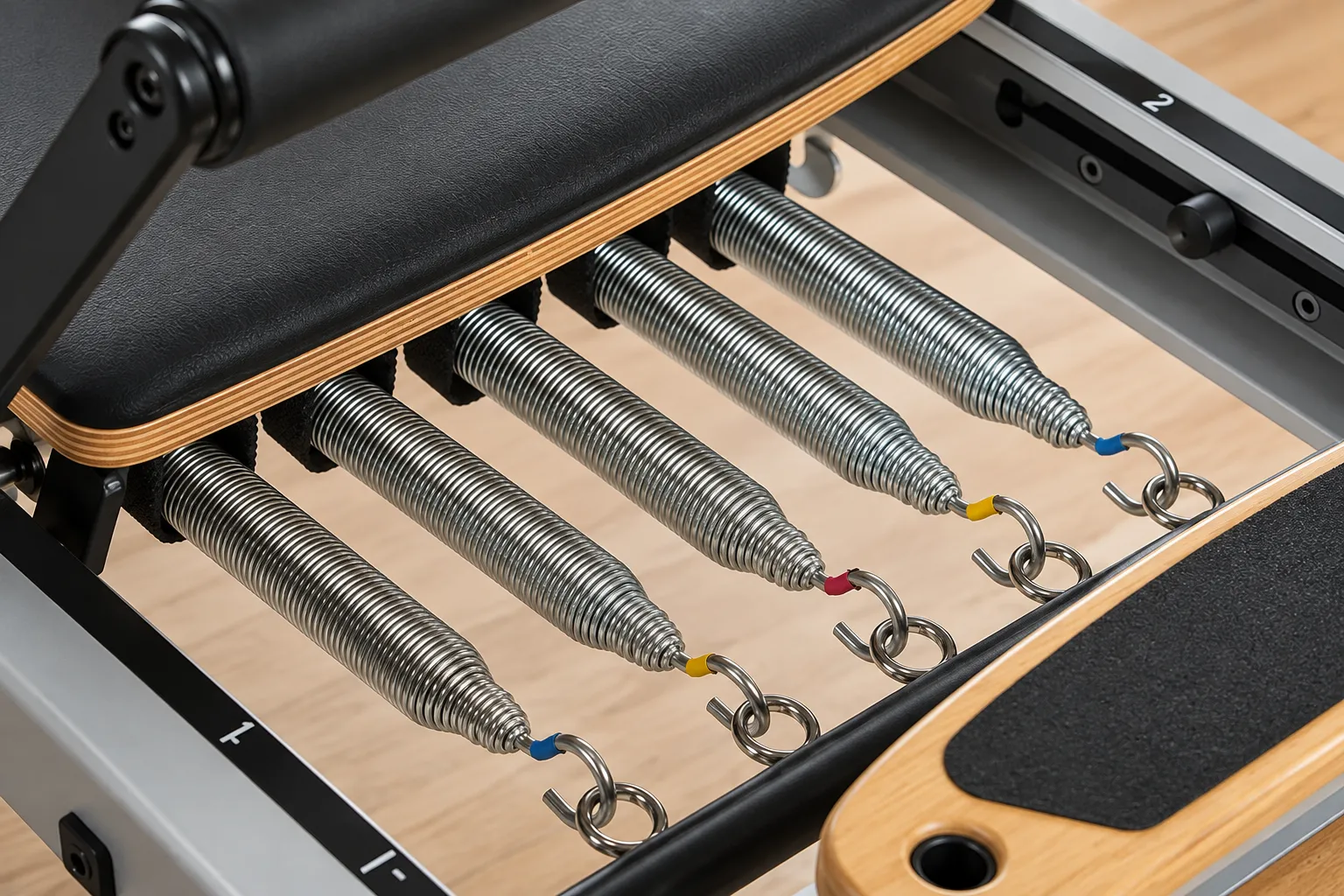
One of the most important – and at the same time most frequently misunderstood – elements of the reformer is the spring system. It’s easy to assume that the more springs, or the stronger the springs, we use, the harder the exercise will be. In Pilates, however, this isn’t always true.
Springs do not simply replace weights: they also provide resistance, support, feedback and stability. That is precisely why the same spring setting can make one exercise more difficult, whilst making the movement easier in another.
Choosing the right spring resistance is therefore not about „how much weight we can handle”. Rather, it is about what kind of movement we want to create, how much support the body needs, and what level of control the exercise in question requires.
But what do ‘light’, ‘medium’ and ‘heavy’ springs actually mean? Why can an exercise be more difficult with less resistance? And why isn’t it a good idea to compare two different reformers simply on the basis of the colour of their springs?
What does the spring in a reformer actually do?
The moving carriage of the reformer is connected to the machine’s frame by springs. When the carriage is moved away from its starting position, the springs stretch and exert resistance. When the carriage returns, the pulling force of the springs assists its movement back to the starting position.
However, the practitioner’s task is not simply to overcome this resistance.
We maintain contact with the spring throughout both phases of the movement. We must control the carriage’s forward movement, and then also guide its return, so that the spring does not „snap it back” to its starting position.
This is one of the fundamental differences between the reformer and a traditional weight-training exercise.
The spring does more than just make movement more difficult. In certain situations it provides resistance, whilst at other times it offers support, and all the while it provides constant feedback on the quality of your control.
What does ‘light spring resistance’ mean?
At first glance, it might seem logical that a lighter spring would also mean an easier exercise.
In many cases, it does indeed require less effort to move the trolley. If, for example, you use one foot or arm to work against the spring, the lower resistance can reduce the direct strain on the muscles.
At the same time, the lower spring resistance It could also mean less support and less stability.
If, for example, we are working in a position where we need to keep the moving carriage under control using the stability of our torso, the lighter spring allows the carriage to move much more freely.
In such situations, the body has to work with greater precision in order to maintain balance and the desired position.
This is why it can happen that the same exercise, with less spring resistance, actually presents a greater challenge to an experienced practitioner.
And what does ‘strong spring’ mean?
A stronger spring exerts greater pulling force on the carriage. This simply requires greater physical strength for certain exercises.
In a classic leg exercise, for example, greater resistance may mean that the legs have to push the cart with greater force.
Something similar can happen with many arm or strap exercises.
But here’s one of the interesting aspects of the reformer.
A stronger spring in certain situations It also makes the car more stable.
The car is less affected by a slight shift in its centre of gravity, so a task where the main challenge is maintaining balance or controlling the car may even become easier.
In other words, the „A ”stiffer„ spring is not the same as a ”more advanced’ setting.
Greater resistance does not automatically mean a more challenging Pilates exercise. The real challenge is determined by how the spring alters the movement in question.
Why are there springs of different strengths on a reformer?
So that the same machine can be adapted to a wide variety of exercises and users.
A reformer’s repertoire includes leg work requiring greater exertion, upper-body exercises demanding precise control, stabilisation exercises and movements in which the spring itself helps to support or guide the body.
It would be difficult to achieve all this properly with just one spring force.
The ability to combine different levels of resistance allows the instructor to fine-tune the characteristics of the Reformer to suit the exercise in question.
What do the colours of the springs on Peak Pilates reformers mean?
For Peak Pilates’ current Studio Wood Line and Metal Line reformer springs, the manufacturer uses different colours to indicate the resistance levels.
The meaning of the spring colours
In the current standard configuration with five springs one red, two yellow and two blue springs can be found. This feature is available on the fit™, MVe® and casa™ reformers, amongst others.
However, this does not mean that a particular colour will evoke exactly the same feeling in every reformer.
Peak Pilates specifically points out that, for example, the resistance characteristics of a blue spring from the Classical range are not necessarily the same as those of a blue spring found on an MVe® reformer.
The springs in different machine series may differ from one another, so the colour alone not a universal unit of measurement.
This is even more true of machines made by other manufacturers.
Why might two reformers who are exactly the same feel different?
This might seem a bit strange at first.
Two machines of the same type, with springs of the same colour, should, in theory, provide the same feel. In practice, however, minor differences may arise.
Springs are subjected to continuous mechanical stress during use. Their age matters, as does the frequency of use and how intensively they have been used.
The positioning of the springs can also affect the balance of the machine and the overall „feel” of the Reformer.
That is why an experienced Pilates instructor does not simply look at which colour spring is engaged.
He can feel the machine.
If there are several Reformers in a studio, over time the instructor may also notice that one of the springs on a particular machine reacts differently from the others.
Why can’t you simply choose a spring based on body weight?
Body type can, of course, influence how the Reformer behaves, but body weight alone is not sufficient to determine the correct setting.
Two people of the same weight may have completely different levels of movement control, strength, mobility and experience of Pilates.
What’s more, the same person may require a different spring setting for two consecutive exercises.
The aim of one exercise might be to exert greater effort, whilst in the next one we might want to challenge stability or precise control.
Therefore, the choice of spring depends primarily on for the purposes of the exercise and based on the participant’s current abilities sets off.
The spring can also provide support
This is perhaps one of the most important factors in understanding the reformer.
A spring isn’t always an adversary.
In certain exercises, it specifically aids movement. It can help the body stay on a particular path, assist in initiating a movement, or create an environment in which the practitioner can more easily experience the correct movement pattern.
This makes the reformer particularly valuable as an educational tool.
With the right amount of spring resistance, it is possible not only to control how demanding a task is, but also, what kind of feedback the practitioner receives from their own body whilst doing so.
What happens if we choose a spring that is too strong?
If we use an unreasonably high level of resistance for an exercise, the quality of the movement can easily be compromised.
The body may start to compensate. Unnecessary tension may build up in the shoulders, the position of the pelvis may change, or the practitioner may try to perform the movement using momentum, when it should be carried out in a controlled manner.
In such cases, it may be that, on paper, we are working with a „heavier load”, but in practical terms we are producing movements of lesser value.
In Pilates, the aim is not to become as strong as possible at any cost.
And what happens if there is too little resistance?
A spring that is too light can also compromise the quality of the exercise.
If the car moves too freely, the learner driver may lose control, or face a stability challenge for which they are not yet prepared.
With other exercises, the resistance may simply be so low that the load for which the exercise was designed is not achieved.
This illustrates particularly well that Easier does not mean safer.
For a beginner, in certain situations, it is precisely a spring of the right strength that can provide that stable foundation, from which one can then gradually move on.
It is here that the teacher’s role becomes truly important
Adjusting the springs on the reformer looks simple from the outside: you clip on one or more springs, and you’re ready to start exercising.
Behind this deliberate approach, however, A major professional decision lies ahead.
The instructor must take into account the aim of the exercise, the reformer being used, the participant’s experience, strength and quality of movement.
You also need to pay attention to how your body reacts to that particular resistance.
It may be the case that adjusting the spring is not necessary because the task is „too difficult”, but rather because the new setting allows for more precise movement.
A good spring setting does not indicate how strong someone is. It shows the level of resistance at which they can perform the exercise in question to the required standard.
The condition of the springs matters too
The springs in the reformer are wearing parts.
They are constantly stretching and retracting, so they require regular checks.
According to Peak Pilates’ current maintenance recommendations, the Reformer springs It is recommended that it be replaced every two years, or immediately, if early signs of wear – such as thread separation – appear.
This is not just important because of the sensation of movement.
In a studio, springs can also be regarded as safety components, which is why regular visual inspections of them are a fundamental part of machine maintenance.
The manufacturer’s specifications for the model in question must, of course, be followed in all cases.
Summary: What does spring resistance actually mean?
On the reformer, the spring means much more than just resistance.
A stiffer spring may provide greater resistance, but it can also offer greater stability and support.
A lighter spring may offer less physical resistance, whilst demanding much greater control from the body.
Therefore, when using the reformer, it is not advisable to follow the traditional gym logic, according to which progress necessarily means that we must continually increase the resistance.
Pilates has a different aim.
A spring is suitable if it helps to create the quality of movement required by the exercise in question.
It may require more resistance. It may require less. And it may well be that the same practitioner encounters both situations within a few minutes.
In a reformer, the question is not how strong a spring we can use, but rather what that particular spring contributes to the movement.
Frequently Asked Questions
Does greater spring resistance always mean a more challenging exercise?
No. Some manoeuvres require more force to overcome greater resistance, whilst in other situations a stiffer spring makes the car more stable. In such cases, a softer spring can pose a greater challenge in terms of control and stability.
What do the colours of Peak Pilates springs mean?
Compared to the current Peak Pilates reformer springs, the green is Extra Light, the blue Light, the yellow for Standard/Medium, the and the red one is the Heavy indicates the resistance level. However, the exact value may vary depending on the machine family, so you should always refer to the specifications for the specific reformer system.
Does a blue spring mean the same thing on every reformer?
No. Colour codes are not standardised across different manufacturers, and even within the same brand, across different model ranges, the behaviour of a given spring may vary.
As a beginner, is it always better to use a lighter spring?
Not necessarily. A stiffer spring can provide greater stability and support for certain exercises, which can be particularly beneficial for beginners. The correct setting should always be determined based on the specific exercise and the exerciser’s condition.
When should you replace the springs on a cross-trainer?
According to Peak Pilates’ current recommendations, Reformer springs should be replaced every two years; however, any spring showing signs of wear or damage must be replaced immediately. The user and maintenance manual for the machine in question should always take precedence.
Can the resistance of a spring change over time?
Springs are subjected to mechanical stress during use, so their age and history of use may affect how they feel. This is why it is important to check them regularly and replace them from time to time.
The team of experts at Peak Pilates Hungary
Through the professional content of Peak Pilates, we aim to demonstrate that every detail of the Reformer serves a specific purpose. Spring resistance is not merely a measure of an exercise’s „level of difficulty”, but one of the most important tools for instruction and ensuring quality of movement. The correct setting helps ensure that the practitioner does not simply exert greater force, but moves with greater precision, control and awareness.


