

Opening a Pilates studio: what equipment do you actually need to get started?

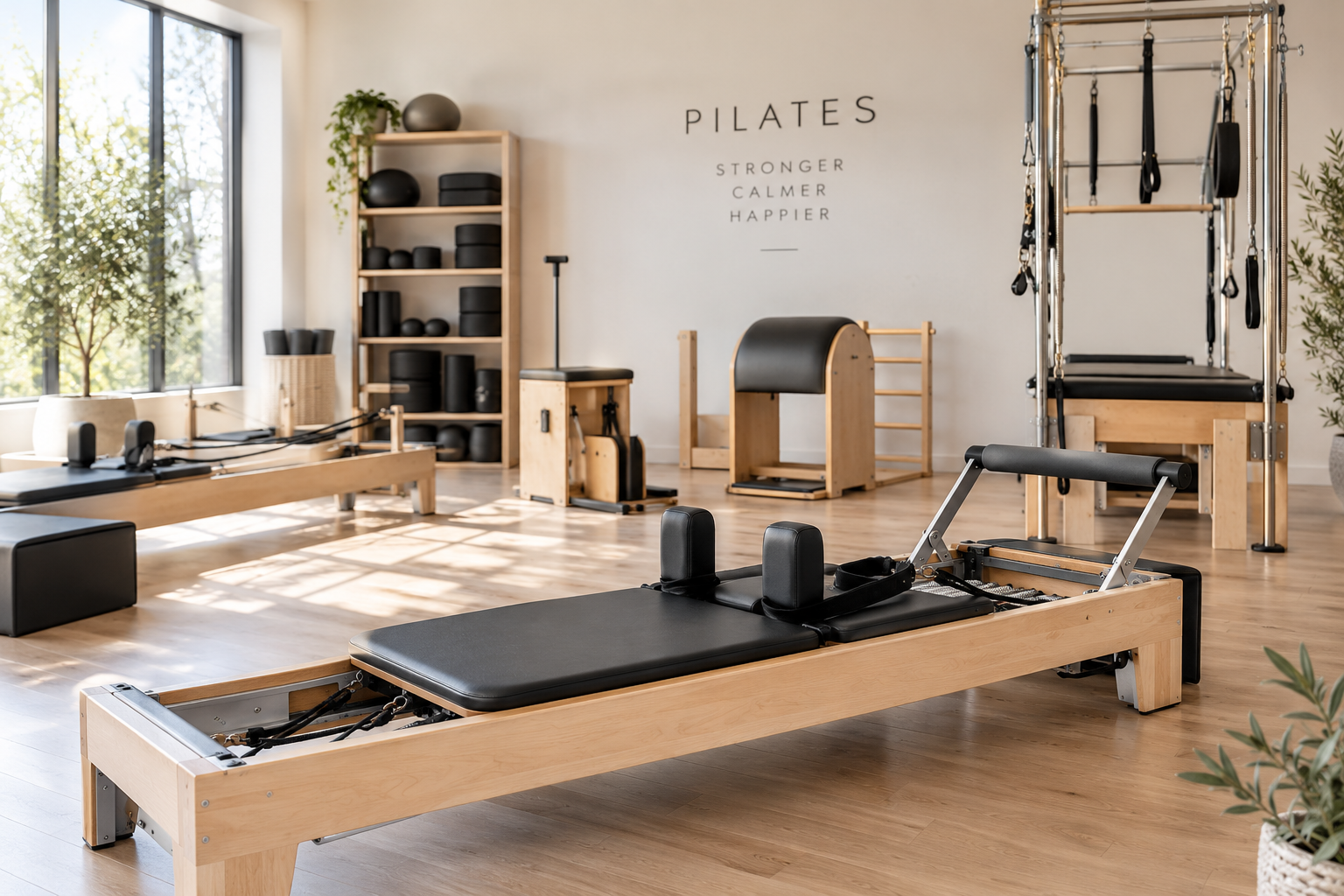
When opening a Pilates studio, it’s easy to think that the more different pieces of equipment you have in the studio, the more professional the service will be. In reality, however, when putting together an initial fleet, awareness is far more important.
You don’t necessarily need every Reformer, Cadillac, Chair and Barrel from day one.
A successful start-up studio begins with equipment that is suited to the types of classes, the instructors’ qualifications, the available space and, of course, the business model.
The classical Pilates system is much more than just a single piece of equipment. In addition to mat exercises, the Reformer, the Cadillac or Tower, the Chair, various Barrels and other supplementary equipment are all part of the full repertoire.
However, this does not mean that a start-up studio necessarily has to buy everything at once.
The most important question is what sort of Pilates studio we would like to run during the first year or two.
Which devices could play a role in the equipment fleet?
Reformer
The foundation of most reformer-focused studios. For group classes, this typically represents the most significant initial investment.
Tower
It can significantly expand the range of exercises, and in a combined reformer system it can make particularly efficient use of space.
Cadillac
For individual and classical Pilates sessions, it is an exceptionally valuable piece of equipment, but it is not a priority investment for every new studio.
Chair
Despite taking up very little space, it allows for a wide range of new strength, stability and control exercises.
Barrel tools
From the Spine Corrector to the Ladder Barrel, these can add a new technical dimension to classic Pilates programmes.
Mat space and accessories
A versatile space, which is ideal for lessons, mobility work, training and extra-curricular activities.
First, let’s draw up a studio concept rather than a list of equipment
Before choosing your first gym, it is worth determining exactly which services will form the backbone of the studio.
A completely different set of equipment is required in a boutique studio that focuses mainly on Reformer groups of 6–10 people, compared to a venue that primarily offers one-to-one Pilates sessions, classic full sessions and personalised training.
If the core of the business model is group Reformer Pilates, then naturally the number and layout of the Reformers become the top priority.
If, on the other hand, the focus is on individual Pilates training, a Cadillac, a Chair or various Barrel apparatus can be of much greater value right from the start.
What makes a professional Pilates studio truly complete is not the fact that it contains every piece of equipment available. What makes it truly complete is that the equipment on offer supports the method that the instructors actually teach.
The Reformer: the cornerstone of most studios’ equipment range
Whether you’re setting up a classic or modern Pilates studio, the Reformer is almost always one of the most important investments.
There is a simple reason for this.
The reformer is extremely versatile. Thanks to its spring resistance, moving carriage, footbar and strap system, it can be used to teach an extremely wide range of exercises, from beginner to advanced levels.
In group lessons, too, it plays a key role from a business perspective.
If, for example, a studio wishes to run Reformer classes for eight people, then eight identical or at least very similar machines will form the basis of its operations.
A standardised fleet of vehicles offers a significant advantage in such situations.
The instructor can communicate the same spring settings, footbar positions and instructions to the whole group.
Peak Pilates’ professional range includes studio reformers with metal and wooden frames, including the fit™, MVe® and Artistry® product lines, amongst others.
How many reformers should you start with?
There is no one-size-fits-all answer to this.
It isn’t necessarily the best studio that crams as many machines as possible into the room.
The number of machines is determined by the available floor space, the planned number of lessons, the teaching capacity and the business plan, taken together.
A small boutique studio can start out with as few as four to six Reformers, whilst a studio specifically designed for group classes can operate efficiently with eight to ten or more machines.
The most important thing, however, is to ensure there is sufficient space between the machines.
The instructor must be able to reach the guests, participants must be able to get on and off safely, and during the exercises, arms and legs often extend beyond the physical width of the machine.
The Artistry® Reformer, for example, is approximately 229 cm long and 66 cm wide, but when planning how to use it, you need to allow for a much larger range of movement than the machine’s actual dimensions.
Tower: is it needed right from the start?
Not in every studio.
But in many cases, it can be a very good investment.
Tower significantly expands the range of exercises available.
With the push-through bar, the roll-down bar, and the arm and leg springs, the programme can include movements that cannot be performed on a standard Reformer, or can only be performed in a different way.
As well as the stand-alone Tower, there are also systems that are combined with a reformer.
The Peak Pilates MVe® Reformer and Tower, for example, enables Reformer, Tower and mat work all in a single system.
The Artistry® TWS, meanwhile, combines a classic reformer and an integrated half-Cadillac Tower on a single wooden frame.
This can be particularly useful in a smaller studio.
Instead of setting aside separate space for a Reformer and a Tower or Cadillac, the same square metre can be used for a variety of Pilates exercises.
If the studio has limited floor space, a multifunctional machine is not just a space-saving solution. It can also make more efficient use of the available space from a business perspective.
Does a start-up studio need a Cadillac?
This depends largely on the studio’s artistic direction.
The Cadillac is one of the key pieces of classic Pilates equipment.
It offers a wide range of exercises, and can be particularly valuable for one-to-one tuition, more complex training programmes and in studios where the use of the full classical system is an important part of the service.
Pilates is not solely a reformer-based system: alongside the reformer, the Cadillac/Tower, Chair, Barrel and other pieces of equipment together form a more comprehensive range of apparatus.
However, for a new studio based primarily on larger groups of reformers, a Cadillac is not necessarily the first investment.
In many cases, it makes more sense to establish the reformer’s capacity first, and then, as the client base and individual services develop, to add a full-scale Cadillac at a later stage.
However, if one-to-one classical Pilates sessions are important right from the start, then the Cadillac may become necessary much sooner.
Chair: a surprisingly wide range of possibilities in a small space
The Pilates Chair is one of those pieces of equipment that it’s easy to underestimate in new studios.
Yet it takes up relatively little space, whilst an extremely varied range of exercises can be built around it.
The Chair can be used for strength, stability, balance and control exercises, and can provide a completely different kind of challenge to the Reformer.
That is why, in a studio where private lessons are also offered, even just one or two Chair machines can significantly expand the options available to instructors.
Peak Pilates offers a range of Chair designs, including MVe® Fitness Chair models and the more classic Artistry® Wunda, Low and High/Low Chair versions.
It is not necessarily the case that every reformer needs a Chair.
That is precisely the advantage.
One or two Chairs can open up entirely new programming possibilities even in a small start-up studio.
Barrel tools: they may not be flashy, but they are valuable from a professional point of view
The Ladder Barrel, Spine Corrector and smaller Barrel apparatus are often less eye-catching than a Reformer or a Cadillac.
Nevertheless, they can be important components of a more comprehensive Pilates studio.
With the help of Barrels, you can create a different environment for, amongst other things, spinal mobility, extension and lateral flexion exercises, as well as various balance and control exercises.
The Peak Pilates Barrel range includes the High Ladder Barrel, the Spine Corrector, the Instep Barrel and Half Barrel equipment in various heights.
However, at the outset, it is not necessarily the case that all versions are required.
A smaller Spine Corrector or Barrel is easier to fit into both the budget and the space, whilst a large Ladder Barrel may only be truly justified if the teaching programme uses it on a regular basis.
The mattress area remains important
In a Pilates studio with machines, it’s easy to focus all your attention on the Reformers.
Yet Mat Pilates remains an important part of the system.
This is also of interest from a business perspective.
A separate area with mats provides the opportunity to hold classes that do not require a significant investment per reformer.
It can also be used for individual exercises, warm-ups, mobility work or even for instructor training courses.
Mat and apparatus exercises do not need to be treated as separate categories.
In a new studio flat, therefore, you don’t necessarily have to fill every last square metre with a reformer.
What about the smaller accessories?
These are generally not the largest items in the investment, yet they can significantly enhance the studio’s usability.
Jump Board, Long/Short Box, various loops, Power Circle or smaller Pilates accessories mean that the same reformer can be used in a much wider variety of programmes.
Here, however, it is once again worth starting from the actual timetable.
It doesn’t necessarily make sense to buy a full set of every piece of equipment straight away, if the teachers do not yet plan to use them on a regular basis.
In the Peak Pilates MVe® product range, for example, for the reformers, the Long/Short Box, Jump Board and Tower extensions are also available, meaning that the equipment can be upgraded gradually.
For many start-up studios, this may be a better option than buying everything on the first day.
The qualifications of the trainers determine what is worth buying
This is perhaps one of the most important and least discussed issues.
A piece of equipment does not, in itself, create a new service simply by being brought into the studio.
The teacher must know how to use it.
If, for example, no one has the necessary Chair or Cadillac repertoire and teaching experience, then an expensive new piece of equipment could easily end up as nothing more than a decoration.
Therefore, the development of the fleet and the training of instructors must go hand in hand.
The Peak Pilates Comprehensive training course does not focus exclusively on the Reformer: the Mat, Reformer, Cadillac/Tower, Chair, Barrel and supplementary equipment are presented as part of an integrated system.
The professional standard of a studio is not determined by the number of machines it has. Rather, it is determined by the extent to which the instructors are able to use the equipment at their disposal in a skilful and informed manner.
A good starting fleet is not necessarily a complete fleet
At a studio specialising in group reformer classes, the order in which participants take their places can, for example, be very straightforward.
First of all, you need a sufficient number of reformers designed for professional use.
It is then worth adding accessories that actually feature in the daily timetable.
If one-to-one sessions or traditional Pilates sessions are to be included in the service, it is worth expanding the equipment range to include the Chair, the Tower or the Cadillac.
Barrel systems, meanwhile, can add a further layer of expertise to this.
But that doesn’t mean you have to do all of this at once.
The reformer, which can be expanded with the Tower, is particularly interesting when starting out
If the budget or floor space is limited, it is worth ensuring right from the start that the core equipment can be upgraded at a later date.
The Artistry® Reformer, for example, was designed so that it could be upgraded later with the Tower system.
The design of the reformer frame supports retrofit Tower Retrofit systems.
This is particularly interesting from a business perspective.
The studio can start out with standalone reformers, and then, once the client base and the services offered warrant it, individual machines can be converted into more complex stations.
This means you don’t necessarily have to pay for the entire future fleet on the very first day.
Let’s not forget about maintenance either
At a new Pilates studio, every piece of equipment arrives in perfect condition.
However, this will not automatically remain the case.
Professional use requires regular checks.
Visual inspection of the machinery, fastenings, springs, straps and other mechanical components is part of regular maintenance to ensure long-term operation.
That is why, when purchasing machinery, the availability of spare parts and serviceability are also important considerations.
A reformer isn’t a one-off purchase.
Work tool.
If, in a room with eight computers, one computer is out of action for a prolonged period, that is not just a technical problem.
You could even reduce the maximum number of pupils per class.
In what order should you develop them?
There is no general rule, but in the case of a Reformer-focused studio, it may make sense to first set up a standardised, professional Reformer fleet, and then to develop it further based on actual client needs and the instructors’ skills.
If the number of one-to-one lessons increases, a Chair or Tower could be the next step.
If the classic, comprehensive Pilates system is becoming increasingly prominent, the Cadillac and the Barrel may make an appearance.
And if group classes are the main focus, it may well be that it is far more worthwhile to purchase additional Reformers or a full set of Jump Boards, rather than a piece of equipment that is only used once a week.
Equipping a studio is therefore not simply a matter of buying products.
The premises, the services, the teaching staff’s expertise and the equipment together form a functioning system.
Summary: What Pilates equipment do you actually need to get started?
It is not worth putting together the equipment for a new Pilates studio based on a single „must-have shopping list”.
At a boutique studio specialising in reformer training Having the right number of reformers suitable for professional use forms the basis.
If the service is designed to accommodate personalised and more complex Pilates work, right from the start or within a short space of time, a Tower or a Cadillac, one or two Chairs, and later the Barrel equipment can prove to be a very valuable addition.
The mat area and the appropriate smaller accessories provide flexibility for the timetable without having to fill the hall with more large pieces of equipment.
The aim is not for everything to be ready on the opening day.
The aim is to Every piece of equipment available should have a clear function in the running of the studio.
A good Pilates studio is not professional simply because it is full of equipment. It is professional because every piece of equipment has been carefully selected, and every square metre supports the guest experience and the professional practice.
Frequently Asked Questions
Do you need a Cadillac for a new Pilates studio?
Not necessarily. If the studio is primarily based around group Reformer Pilates classes, the Cadillac can be introduced at a later stage of development. In a studio, however, which is based on one-to-one, classical Pilates work, it may be of much greater importance right from the start.
How many Reformers should you have to open a studio?
This depends on the floor area, the type of class planned and the business model. It is not worth aiming for the maximum number of machines that can be squeezed in, but rather the number at which both participants and the instructor can move around comfortably.
Is a Chair essential in a reformer studio?
It isn’t necessarily something you’ll use from day one, but it can be an extremely useful addition. It takes up very little space, whilst enabling a whole range of different exercises and movement challenges, which is why it can be particularly valuable in one-to-one sessions.
Is the Tower or a separate Cadillac the better choice?
This depends on the venue and the service concept. A Tower combined with a reformer can offer a highly versatile solution in a smaller space, whilst a full-size Cadillac in a classic Pilates studio provides a separate, comprehensive workstation.
Does every reformer need a Jump Board?
Not necessarily. If the Jump Board features regularly in the group class programme, it is worth ensuring that the entire fleet is equipped with it. If it is only used occasionally in one-to-one sessions, a smaller number may be sufficient.
Is it important for all reformers to be the same?
A significant advantage for group classes. With a standardised range of equipment, it is easier for instructors to communicate, to manage resistance levels and settings, and to carry out maintenance. In a personalised studio, however, the use of a variety of equipment can offer a distinct professional advantage.
Is it worth choosing a reformer that can be upgraded with the Tower right from the start?
If it is expected that the studio will be expanded with the Tower programme at a later date, then yes. This means the hardware can be upgraded gradually without having to purchase completely new base machines.
The team of experts at Peak Pilates Hungary
Peak Pilates offers a professional Pilates system ranging from the Reformer and Tower to the Cadillac, Chair and Barrel apparatus, which is based on various elements of the classical method. Through our professional content, we aim to help ensure that the equipment selection for a new Pilates studio is not simply a shopping list, but a carefully planned system. The right equipment isn’t necessarily the most extensive – but rather, the one that can grow alongside the studio.


