

How many instructors should you start a Pilates studio with?

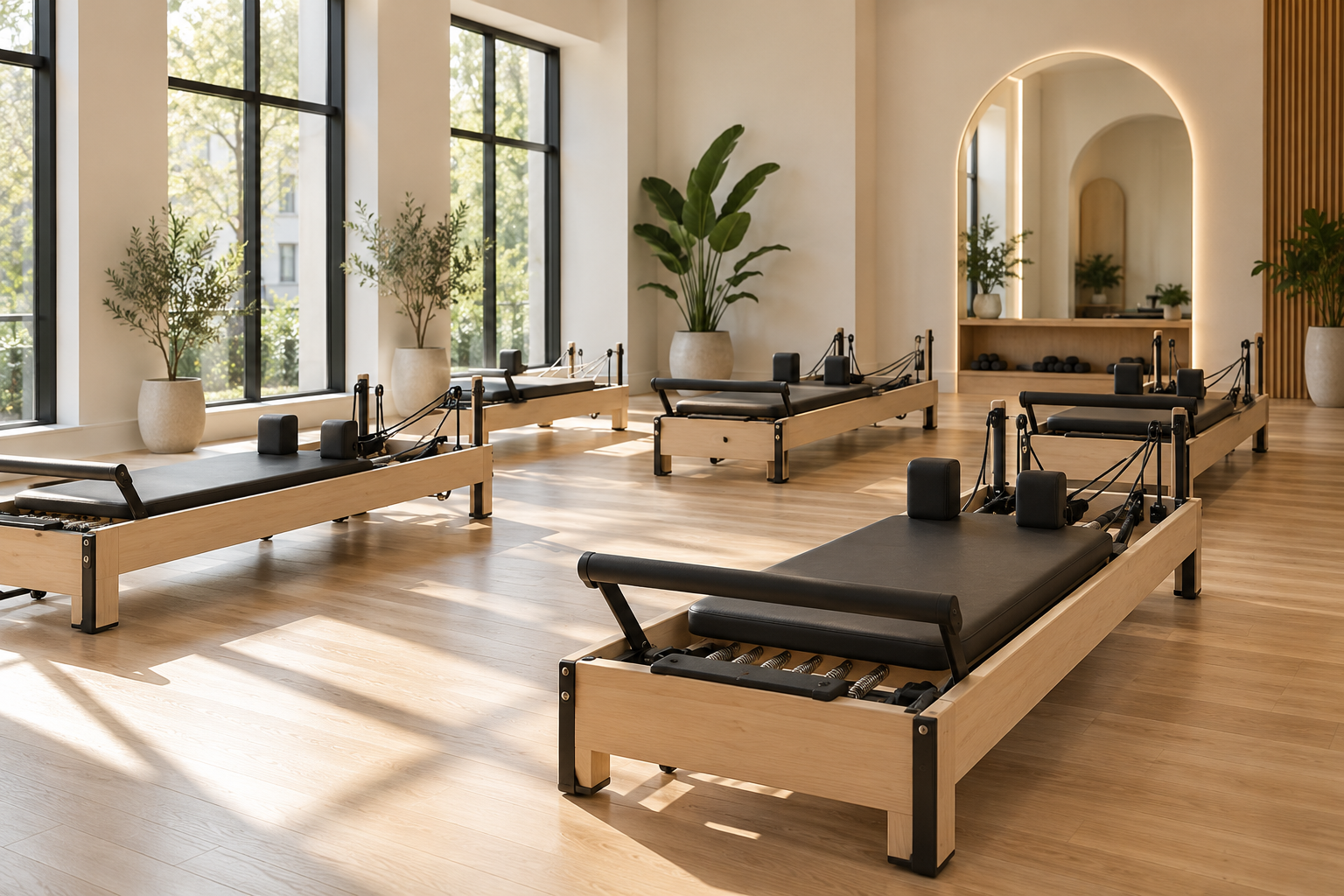
Four, six, eight or even ten reformers? When designing a new Pilates studio, this is one of the most important considerations, as the number of machines determines the scale of the investment, the maximum class size, the space required and future revenue potential.
However, having more reformers does not automatically mean a better business model. A well-run boutique studio with six machines can operate much more sustainably than a gym with ten machines, where classes are regularly half-empty.
That is why there is no general rule stating that a Pilates studio must start out with at least eight or ten reformers.
The appropriate number of machines depends on the sort of classes we wish to run, how many students we can realistically attract, how many instructors we have, how much space is available, and at what cost level we wish to launch the business.
The most important question, therefore, is not how many Reformers the hall can accommodate, but rather how many Reformers we can actually fill with guests.
4, 6, 8 or 10–12 reformers?
Pilot / small boutique studio
Lower initial investment, a personalised, small-group experience and a good opportunity to test local demand.
A strong boutique middle ground
It can strike a good balance between personalised attention, class capacity and the initial investment risk.
Definite group model
Greater lesson capacity, but a standardised fleet of vehicles, structured lesson delivery and proven demand from guests are now more important.
A studio based on volume
Higher revenue potential, but this is only justified if the location, the marketing and the customer base all support it.
Four Reformers: a good way to get started at a smaller boutique or pilot studio
At first glance, four aircraft might seem like a small number, but for certain business models, it can represent a deliberately calculated start.
A Reformer class for four people already offers a genuine small-group experience.
The instructor can stay close to all participants, correct their movements more easily, and give them more personalised attention.
This can be particularly useful if you wish to introduce Reformer classes alongside an existing personal training or Pilates service, or if you’d like to gauge local demand first.
The initial investment is also significantly easier to manage.
It is not just a matter of buying four coffee machines instead of eight or ten. Fewer accessories, a smaller premises and, where applicable, lower initial investment may be required.
The trade-off, of course, is capacity.
If a strong customer base builds up quickly, the four places may soon prove insufficient, and during popular times a waiting list may form.
However, this is not necessarily a bad thing.
A smaller studio that fills up regularly may be a more sensible starting point than a large fleet of machines, whose capacity we won’t be able to utilise in the first few months.
Six reformers: the ideal middle ground for many start-up boutique studios
If I had to single out just one piece of equipment for setting up a classic, small-group reformer studio, Six machines could be a major compromise.
It already provides sufficient capacity to ensure that group lessons run cost-effectively, whilst the tutor continues to work with relatively small groups.
With just six participants, it is still easy to maintain that more personalised, boutique-style experience, which is why many guests choose a smaller Pilates studio over a larger fitness centre in the first place.
Investment risk, too, remains more moderate.
If, for example, in the first few months an average of three or four guests turn up per hour, that does not mean there are six further unused reformers in the studio.
As the number of guests grows, the six-person classes can gradually be filled, and it is already becoming clear whether the next stage of expansion is justified.
Eight reformers: when we’re clearly thinking in terms of a group business model
With eight machines, the studio’s operations take on a different character.
In a class of eight people, the instructor has to keep an eye on the movements of several people at once, which is why it is all the more important to have a standardised range of equipment, a well-planned class structure and a reformer that is quick and easy to operate.
The Peak Pilates fit™ model, for example, offers features specifically designed for studio use: a one-handed gear bar, a four-position footbar, adjustable ropes and a design that facilitates space-saving storage are all included.
For eight Reformers, even from a business perspective, the significance of a single additional guest is much more apparent.
If the hourly rate is charged per person, then the revenue from a full hour’s session with four participants and one with eight participants could differ by a factor of two, whilst the basic costs of the instructor and the venue do not necessarily double.
This is what makes the ‘larger group’ reform model so appealing.
But only if, if there really is a demand.
Ten or twelve reformers: we need to start thinking in terms of scale
With ten or more reformers, we are now clearly talking about a group Pilates studio.
This is where operational efficiency becomes even more important.
In a studio like this, the changeover between classes must be quick, the machine settings must be communicated clearly, and the instructor must be positioned so that they can see the whole group.
The acoustics, lighting and layout of the hall are also given greater importance.
With ten people, it is more likely that a participant at one end of the room will have difficulty hearing the instructions, or that the instructor will find it harder to reach everyone.
That is why a studio of this size is not simply a larger version of a six-machine room.
You need a different operating system.
At the same time, however, a larger customer base could represent significant revenue potential, particularly if several peak-time hours each day operate at high capacity.
But the other side is just as important: a class of four people in a room with twelve machines means something quite different, both visually and commercially, than in a studio with six machines.
It doesn’t matter how many reformers can physically fit in
When designing a studio, it’s easy to get the floor plan out, check the dimensions of the reformer, and then start drawing the machines side by side.
However, this is a dangerous approach.
The Peak Pilates fit™ Reformer, for example, is approximately 246 cm long and 64 cm wide, whilst the MVe® is roughly It is 263 cm long and 74 cm wide.
However, these are simply the dimensions of the machine itself.
During a workout, the client’s arms, legs and body may extend beyond the physical dimensions of the Reformer.
For certain exercises, lateral space is required, and the instructor must be able to reach the participants at all times.
In addition to this, the entrance, reception area, changing rooms, storage area, circulation routes and any additional Pilates equipment will also require space.
That is why a room which, on paper, can just about accommodate ten reformers, might in fact In practice, it’s best to place only eight.
From the point of view of the guest experience, this is often the better choice.
The utilisation of the hall is more important than its maximum capacity
When setting up a new studio, it is particularly important to be realistic in your calculations.
If we have eight reformers, but in the first year an average of four people take part in each session, then the utilisation rate of the machinery is around 50 per cent.
That in itself is not necessarily a problem, especially at the start.
However, if we serve the same number of guests with six reformers, the same hour is then operating at two-thirds capacity, whilst requiring a lower initial investment.
The aim, of course, is not for every computer to be in use during every lesson.
We need spare capacity to accommodate new guests and to support growth.
But it’s not ideal either if, for a long time, we only use half the room.
The right number of machines leaves enough room for growth, but does not involve financing unused capacity for years to come.
The number of reformers also has an impact on pricing
There is more to the difference between a group of four and a group of ten than just the number of people.
We also offer other services.
A class for four people is easier to market as a premium, more personalised small-group training session.
The tutor is able to provide more personalised feedback, so a higher fee may be justified.
A class of eight to ten pupils, by contrast, may offer greater capacity and potentially lower operating costs per pupil.
No single model is automatically better.
In a smaller town, it may well be that a boutique studio with four to six staff, offering a more personalised service, works well.
In a densely populated urban area, however, a model comprising eight to twelve reformers, operating for a high number of hours, may be more cost-effective.
The issue must also be considered from the teachers’ perspective
Not every trainer wants to or is able to lead ten to twelve people at once to the same standard.
In Pilates, the following are particularly important: the quality of the movement, correct machine adjustment and precise instruction.
The larger the group, the more a structured approach to teaching is required.
Peak Pilates also offers a dedicated FITCORE™ Group Reformer training course, which is specifically designed to prepare participants to teach group Reformer classes, set up the machine correctly, provide cueing and lead structured classes.
This clearly shows that increasing the size of the group is not simply a business decision.
It’s also an educational issue.
In the case of a smaller, six-machine studio, therefore, putting together the teaching team may also be easier, particularly at the outset.
What if we need more machines later on?
Ideally, we plan this before the opening.
If we start with six reformers, but the premises are designed so that they can be expanded to eight later on, we can get started with much less risk.
However, right from the start, it is worth making provision for suitable access routes, lighting, storage and space for future machinery.
The choice of machine can also affect flexibility.
In Peak Pilates’ product range, the fit™ reformer, for example, allows several machines to be stacked on top of one another, and, thanks to its integrated wheel system, can also be adjusted to a vertical position.
The design of the MVe® also facilitates multi-unit, more flexible studio use.
This can be particularly valuable in a studio where the same room is occasionally used for Mat Pilates, workshops or other exercise programmes.
Is it worth investing in the final size straight away?
Not necessarily.
Whether the studio is launching with an existing client base, we carry out pre-sales, we have a strong location, or we have accurate data from our previous studio on expected demand, then it may be justified to start with a larger fleet of machines.
However, when setting up a completely new business, it is often wiser to start with a slightly smaller capacity.
In one of the programmes showcased by Peak Pilates, a YMCA It tested the concept with just four reformers, and then, spurred on by the programme’s success, it began to expand.
From a business point of view, that’s a very sound way of thinking.
First, we demonstrate that there is demand. Then we increase capacity. Not the other way round.
Four, six or eight? How should we approach this at the start?
If you’re looking for a small, premium, more personalised Pilates studio, where the focus is on individual attention, 4–6 reformers It could be a very realistic starting point.
If we are clearly thinking along the lines of a group boutique model, and the right location, marketing framework and prospective customer base are available, 6–8 reformers This could be a start-up configuration that works very well.
A A studio with 10–12 machines It is more suited to a business model where greater hourly capacity is a deliberate objective, and we have a realistic plan for how we will consistently fill these places.
This isn’t a strict rule.
But it provides a good framework for thinking.
The most important figure is not, in fact, the number of reformers
It’s the occupancy rate.
Let’s suppose that there are two studios operating in the same town.
In one of them there are ten reformers, but on average four of them attend the lessons.
The other one has six machines, and there are usually five or six guests taking part.
On paper, the first studio is bigger.
From a business perspective, however, it may well be that the second option is the more sound one.
What’s more, high capacity utilisation can also boost demand psychologically.
If guests see that popular time slots fill up quickly, they are more likely to book in advance and establish a regular routine.
In contrast, a hall that is constantly half-empty is less likely to convey a strong sense of community.
Summary: How many reformers should you start with?
There is no single perfect number.
One 4 Reformer studios It could be suitable for a pilot, a more personalised service or a small boutique-style concept.
A 6 reformist models For many start-up studios, it can strike a very good balance between personal attention, revenue potential and the initial investment.
A 8 Reformer studios It now enables more intensive group-based operation, and, provided there is sufficient demand, ensures a significantly higher hourly capacity.
A 10–12 or more Reformer models However, it is only truly justified if the location, the customer base and the business plan all support operations on a larger scale.
The aim is not to have as many Reformers as possible when we open.
The right number of machines is one that we can operate with appropriate utilisation, a good guest experience and high professional standards.
The question isn’t how many Reformers the studio can accommodate. Rather, it is how many Reformers we can regularly fill whilst ensuring that both the quality of teaching and the guest experience are maintained.
Frequently Asked Questions
Would four reformers be enough to set up a Pilates studio?
Yes. For a small boutique studio, a pilot project or a more personalised small-group service, four Reformers could well be a perfectly realistic starting configuration.
Are six reformers too few for a group studio?
Not necessarily. With classes of six people, it is possible to establish a group model that works well, whilst the instructor is still able to provide a relatively high level of personal attention. For a start-up boutique studio, this can be a particularly good compromise.
Is the studio more profitable with eight or ten reformers?
Only if we actually make use of that extra capacity. More reformers allow for higher maximum turnover, but also entail a higher initial investment and greater space requirements. Utilisation is a more important indicator than the number of machines alone.
How much space should be left between the reformers?
It is not advisable to rely solely on the physical width of the reformer. Participants’ limbs may extend beyond the machine during some exercises, and the instructor must be able to reach every participant. The exact layout should always be planned based on the specific machine, the studio and the type of class being held.
Is it worth starting out with 10–12 machines straight away?
If there is proven demand, an existing client base or strong pre-sales figures to back it up, then yes. However, for a brand-new studio, it is often less risky to start with 4–8 reformers, and then expand based on actual booking figures.
Should all reformers be the same?
For group lessons, this is generally a significant advantage. With an identical fleet of machines, it is easier to communicate spring settings, footbar positions and other instructions, as well as to manage spare parts and maintenance.
How should I plan if I want to expand later on?
Even when drawing up the floor plan, it is worth leaving space for additional equipment, or choosing a reformer that is easy to move and store. It is worth incorporating plans for future expansion into the layout design before the gym opens.
The team of experts at Peak Pilates Hungary
Putting together the equipment for a Pilates studio is both a professional and a business decision. Peak Pilates’ professional reformers offer solutions for a variety of studio concepts, ranging from smaller, flexibly configurable spaces to classic boutique Pilates studios. Through our professional guidance, we aim to help ensure that the size of the equipment set-up is not a matter of guesswork, but is based on the available space, the planned timetable and actual client demand. It’s not worth starting out with the greatest number of reformers – but with just enough to build a studio that actually works well.


